IncidentAI

AI security incident management for lean response teams.

IncidentAI helps teams triage security incidents, classify severity, coordinate owners, map response actions, and preserve a clean incident record with AI-assisted ticketing.

Enterprise access only. aneo provisions IncidentAI after onboarding so workflows, roles, and response records match the customer environment.

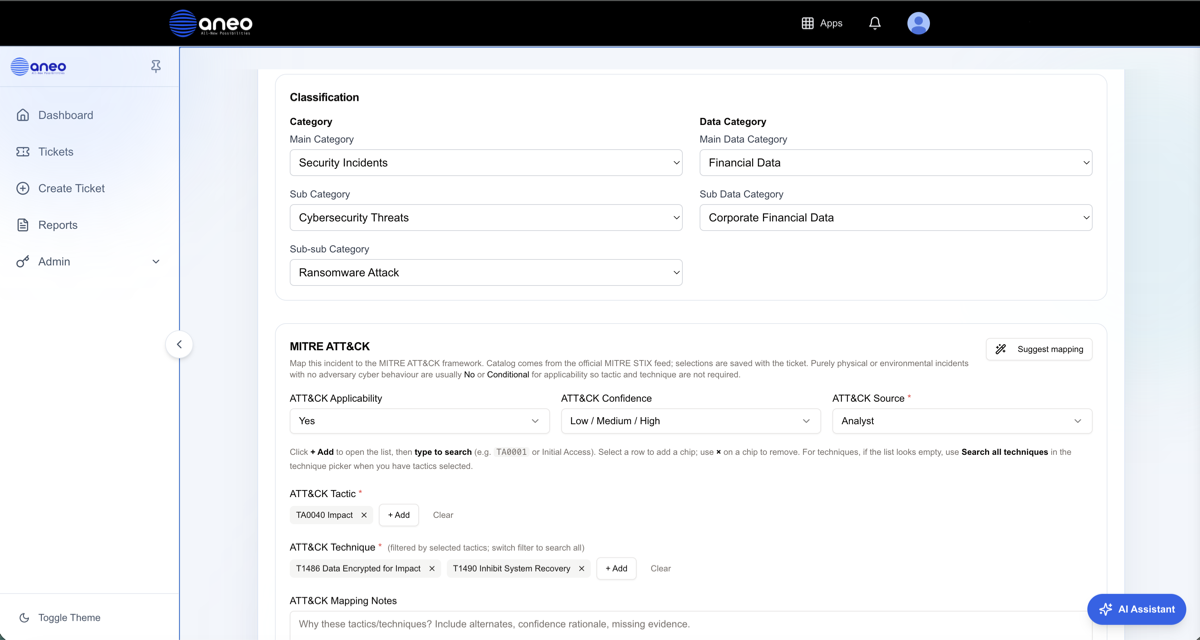
IncidentAI ticket screen showing security incident classification and MITRE ATT&CK mapping
Direct answer

What is IncidentAI?

IncidentAI is an enterprise AI-powered security incident management and ticketing system. It supports triage, classification, ownership, response planning, MITRE ATT&CK mapping, evidence notes, and closure summaries so incident work is easier to act on and easier to explain.

Key outcomes

Bring structure to the first hour and the final record.

IncidentAI is designed for teams that need faster security incident response without losing decision quality, ownership, or auditability.

Faster triage

Classify incident type, severity, affected systems, business impact, and required response actions with AI assistance.

Clear ownership

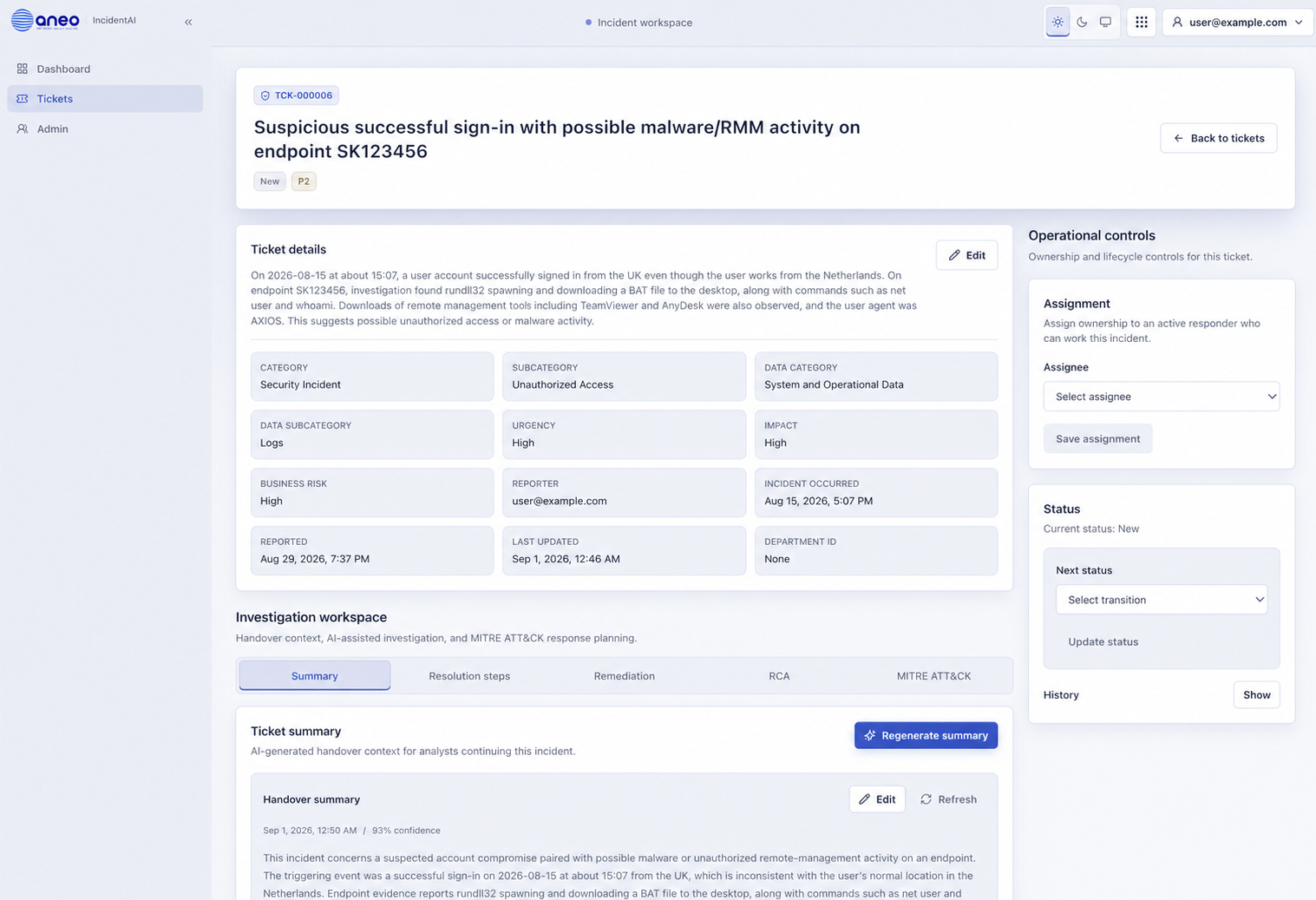
Assign owners, next steps, approvals, and handoffs so security, IT, legal, and operations teams stay aligned.

Better response records

Keep timelines, notes, evidence, rationale, and decisions together for review, reporting, and post-incident improvement.

Less analyst fatigue

Reduce repetitive ticket work with summaries, suggested actions, duplicate checks, and consistent incident documentation.

How it works

A practical workflow for AI-assisted incident triage and response coordination.

The workflow helps analysts move from initial signal to structured response record, with AI support where it reduces manual work and ambiguity.

01

Create or ingest an incident ticket

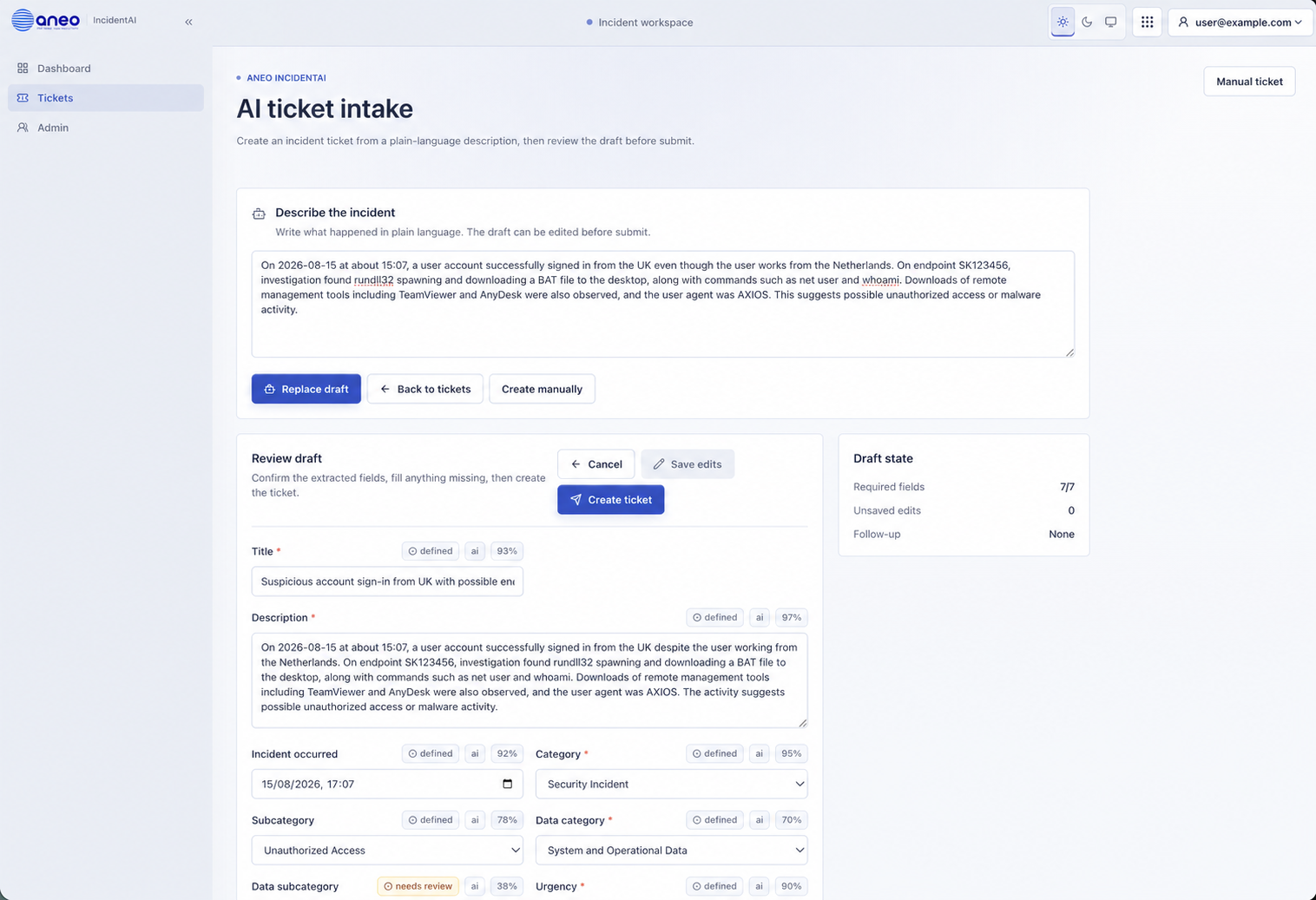
Start from a security event, alert, email, or analyst-created ticket and capture the facts in one structured record.

02

Classify severity and context

Use AI assistance to organize category, data type, impact, urgency, affected assets, confidence, and response priority.

03

Map likely cause and attack context

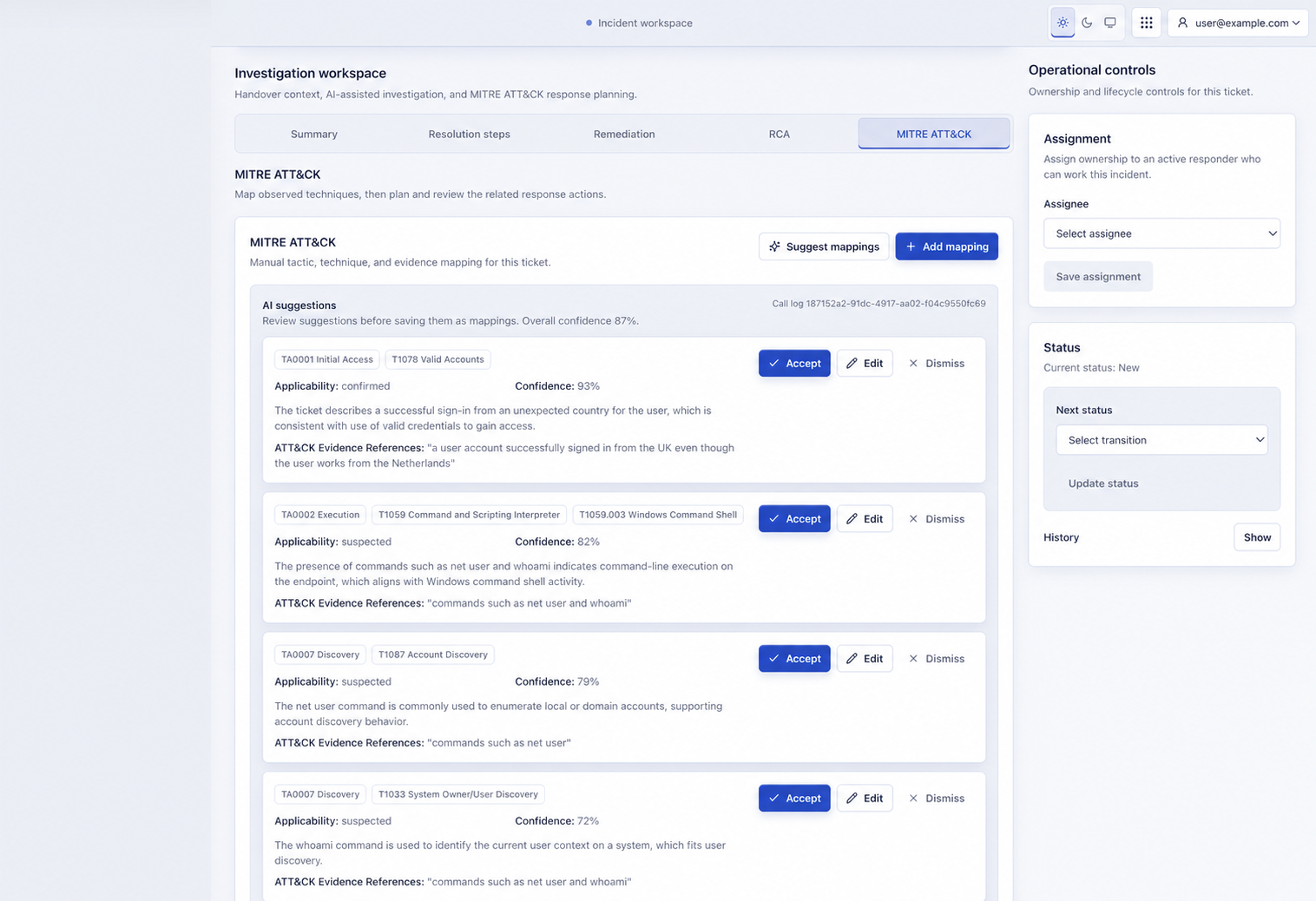
Generate root-cause hypotheses, response rationale, MITRE ATT&CK mapping support, and related incident context.

04

Coordinate response actions

Assign owners, track remediation tasks, request approvals, and keep handoffs visible across the incident lifecycle.

05

Close with a defensible record

Preserve summaries, timelines, decisions, evidence, and lessons learned for internal review and customer conversations.

AI assistance

Use AI where incident work becomes repetitive, ambiguous, or easy to lose.

IncidentAI helps analysts summarize context, reduce noise, propose response paths, and maintain a consistent record while human teams remain in control of decisions and actions.

Natural-language triage summaries for security and IT incidents
Root-cause hypotheses with clear confidence signals
Severity, impact, category, and data classification support
MITRE ATT&CK tactic and technique mapping assistance
Suggested remediation steps, playbooks, and next actions
Duplicate checks and related incident context
Timeline, notes, audit log, and closure summary generation
Handoffs to ticketing or communication tools where configured

Enterprise access

IncidentAI is provisioned after onboarding, not opened as a direct self-service signup.

Security incident workflows are sensitive. aneo sets up IncidentAI with the customer so access, process, data handling, and response expectations are clear before teams start using it.

Provisioned access

IncidentAI is set up by aneo after onboarding so users, roles, permissions, workflows, and response records match the customer environment.

Configured workflows

Teams can align incident categories, escalation paths, approval steps, reporting needs, and playbooks to their operating model.

Human-in-the-loop control

AI suggests classification, rationale, summaries, and next actions. Your team remains responsible for review, approval, and execution.

Trust and control

IncidentAI supports response discipline. It does not replace accountable security decisions.

IncidentAI can draft triage logic, summaries, likely causes, suggested next steps, and response records. Your organization remains responsible for validation, execution, communication, and closure.

  • Role-based access for controlled incident work
  • Human review before response actions are accepted
  • Audit trail and exportable incident history
  • Encryption in transit and at rest
  • Zero data retention options and EU data residency available on request
FAQ

IncidentAI questions, answered directly.

What is IncidentAI?

IncidentAI is an enterprise AI security incident management and ticketing system that helps teams triage incidents, classify severity, coordinate response actions, and preserve a clear incident record.

Can users sign up for IncidentAI directly?

No. IncidentAI is an enterprise product. aneo provides access after a demo and onboarding so customer users, roles, workflows, and incident processes are configured correctly.

Does IncidentAI automatically fix incidents?

No. IncidentAI proposes classification, likely causes, response steps, summaries, and documentation. Human teams review and approve decisions before action is taken.

Does IncidentAI support MITRE ATT&CK mapping?

Yes. IncidentAI can assist with MITRE ATT&CK tactic and technique mapping where the incident has relevant cyber behavior and enough context for analysis.

Who is IncidentAI built for?

IncidentAI is built for lean security, IT, SecOps, MSP, and operations teams that need structured incident handling without adding unnecessary process overhead.

What does IncidentAI help document?

IncidentAI helps document incident classification, severity, data category, suspected cause, response steps, ownership, notes, timeline, decisions, evidence, and closure summaries.

Next step

Book a demo for enterprise AI incident management.

Talk to aneo about IncidentAI access, onboarding, workflows, roles, data handling, and how AI-assisted incident ticketing can fit your response process.