
AI can save a lot of time.
It can summarize long threads, draft policy language, highlight risky contract clauses, suggest likely causes during incident triage, and help teams move faster.
That part is real.
But speed is only useful when the output can still be trusted, challenged, and corrected when needed. NIST’s Generative AI Profile says generative AI often needs different levels of oversight than other tools, and may require additional human review, tracking, documentation, and management oversight. OWASP also lists overreliance on LLM outputs as a core risk because failing to critically assess those outputs can lead to bad decisions, security issues, and legal liability.
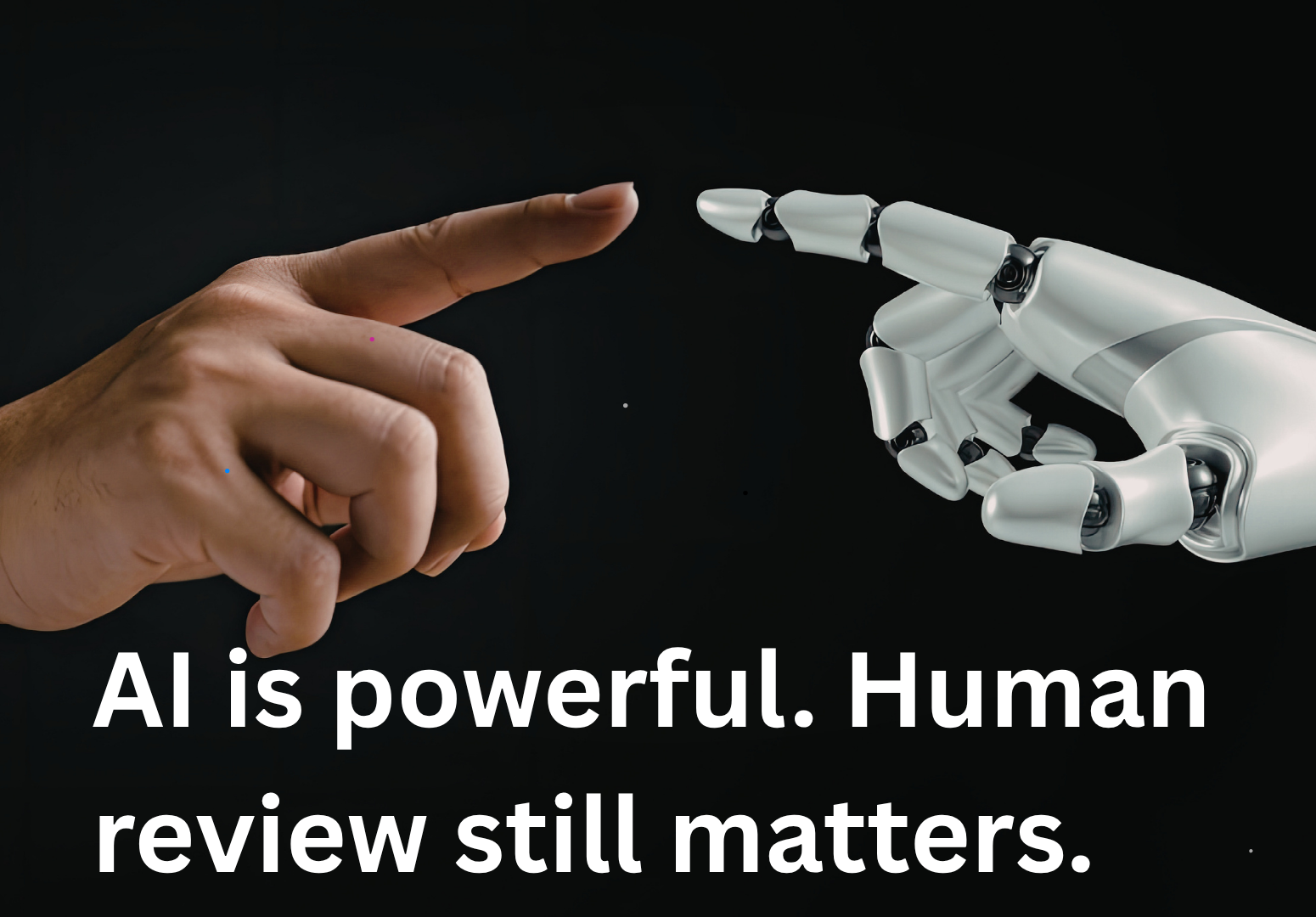
What human-in-the-loop actually means
In simple terms, human-in-the-loop AI means AI helps with the work, but a person still reviews, decides, or approves before the output is relied on in a meaningful way.
That review can happen at different points.
Sometimes a person checks the draft before it is shared.
Sometimes they validate a recommendation before taking action.
Sometimes they review a summary, a control suggestion, or a clause analysis before it becomes part of a real decision.
The point is not to slow everything down.
The point is to make sure speed does not quietly replace judgment. NIST’s AI RMF says governance for generative AI may require different human-AI configurations, additional review, and acceptable-use guidance to reduce misuse, abuse, and misalignment between systems and users.
Why this matters so much in security and legal work
Some work can tolerate rough first drafts.
Security and legal work usually cannot.
A missed contract clause can shift risk in the wrong direction.
A weak policy draft can create false confidence.
A bad triage suggestion can send responders down the wrong path.
A confident but incorrect summary can cause teams to act too quickly or miss what matters.
These are not just productivity issues. They are judgment issues.
That is why review still matters. The EU AI Act uses human oversight as one of the core safeguards for high-risk AI systems, alongside documentation, logging, robustness, and transparency. Even where a specific use case is not classified as high-risk, the principle is still useful: important AI-assisted decisions should not become fully automatic by accident.
The real risk is not only wrong output
One of the biggest problems with AI is not only that it can be wrong.
It is that it can sound right while being wrong.
That is where people get into trouble.
If the language sounds polished enough, it becomes easy to accept it too quickly. If the summary reads confidently, people may stop asking enough questions. If a recommendation looks structured, teams may assume the thinking behind it is stronger than it really is.
OWASP calls this out directly through LLM09: Overreliance, and NIST’s AI guidance makes the same point in a broader way by calling for added review and documentation around generative AI use.
Review is not about distrusting AI completely
This part matters.
Human review does not mean AI is not useful.
It means AI is being used in the right place.
AI is very good at helping teams get to a stronger starting point faster. It can reduce blank-page work, surface patterns, organize information, and suggest directions worth checking.
But it should not quietly become the final decision-maker for security, legal interpretation, or compliance outcomes.
That is why the best AI workflows usually feel like collaboration, not replacement. NIST describes this as different human-AI configurations based on the context and risk of the task, rather than one fixed approach for every use case.
What good human review actually looks like
Good review does not mean reading everything from scratch as if the AI was never used.
That defeats the point.
A better approach is targeted review.
For example:
- checking whether the output matches the business context
- validating whether key facts are correct
- confirming that recommendations are realistic
- spotting anything missing, overstated, or too generic
- deciding whether the output is ready to use, needs edits, or should be rejected
That kind of review is much more practical.
It keeps the speed benefit of AI while still protecting the quality of the final outcome. NIST’s AI RMF says governance measures for generative AI can include auditing and assessment, impact assessments, monitoring, incident response, change management, and role-based qualifications, all of which point to review as part of controlled use rather than blind automation.
Where teams often go wrong
There are a few patterns that show up again and again.
The first is using AI without clear boundaries.
The second is treating AI-generated content as if it were already approved.
The third is assuming that if the wording sounds professional, the reasoning must be sound too.
Those mistakes usually come from unclear ownership.
If nobody is clearly responsible for reviewing, challenging, or approving the output, then the “human in the loop” becomes more of a slogan than a real control.
That is one reason governance matters so much. The European Commission’s AI Act overview links human oversight to broader governance measures like logging, documentation, information to deployers, and post-market monitoring. Review works best when it sits inside a process, not when it is left to chance.
Why this matters for SMEs and growing teams
Smaller teams often feel the time pressure more sharply.
That makes AI even more attractive.
And honestly, that is not a bad thing. Lean teams should absolutely use tools that help them move faster.
But smaller teams also have less room for rework, confusion, or hidden errors.
A contract clause accepted too quickly can create long-term risk.
A policy copied forward without proper review can weaken audit readiness.
A poor incident summary can waste the time of the few responders you actually have.
That is why human review is not bureaucracy. For smaller teams, it is often the thing that keeps speed from becoming expensive later. NIST’s guidance for generative AI highlights that these systems may need additional review, tracking, and documentation precisely because the risks and performance characteristics are often less well understood.
What this looks like in practice
A practical human-in-the-loop model is usually simple:
AI prepares.
Human reviews.
Human decides.
Business acts.
That flow works well across many use cases:
- AI highlights contract clauses, but a person approves the changes
- AI drafts policy language, but a person reviews and finalizes it
- AI suggests likely causes in an incident, but a person decides the response
- AI summarizes a long ticket thread, but a person confirms what matters
This is also how aneo is built to support teams.
The AI helps speed up the work, but it does not replace human judgment, legal review, or accredited audits.
With Clause-Review, users review and approve every change.
With IncidentAI, AI helps triage while the team decides and executes the fix.
With Framework-Pro, AI helps generate policy drafts that users review, refine, and finalize.
Why this approach builds more trust
Trust in AI does not come from pretending the model is always right.
It comes from showing where AI helps, where its limits are, and how people stay in control.
That is true for customers, internal teams, and regulators.
The European Commission describes the AI Act as a framework for trustworthy AI built around risk, transparency, safety, and human-centric use. NIST’s AI RMF is built around a similar idea from the risk-management side: AI should be governed in a way that makes trustworthiness more practical, not more theoretical.
Final thought
Human-in-the-loop AI is not about slowing people down.
It is about keeping important work reviewable.
In security and legal workflows, that matters a lot.
Because the goal is not just faster output.
The goal is faster output that still makes sense, still fits the business, and still holds up when someone asks the hard questions later.
That is where review earns its place.